
Published 13th Nov 2026

Three-fifths of PR boardrooms are now male-dominated, while new research from Global Women in PR warns that AI could reduce entry-level opportunities
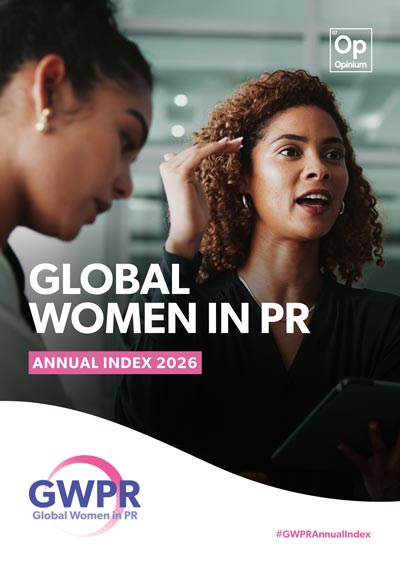
Progress towards gender equality in the global PR and communications industry is going backwards, with the proportion of male-dominated boardrooms rising to 59%, up from 51% in 2025 and returning to levels last seen in 2024.
At the same time, the rapid adoption of artificial intelligence (AI) is raising fresh concerns about the future of the profession, with more than half (51%) of female PR professionals worried that automating junior-level tasks will reduce opportunities to learn on the job. Two in five (41%) fear AI could lead to fewer entry-level roles, potentially making it harder for women to enter and progress in the industry.
The findings come from the Global Women in PR (GWPR) Annual Index 2026, conducted in partnership with Opinium Research. Now in its eighth edition, the Index tracks the experiences and progress of women working in PR and communications around the world, highlighting the challenges facing the industry and where action is needed to achieve greater gender equality.
While AI is transforming how communications professionals work, the research highlights a growing tension between technological progress and the need to develop future talent. With 97% of respondents already using AI day to day, concerns extend beyond job security to the loss of the practical experience and opportunities that help people build PR careers.
Structural barriers to women’s progression also persist. Although women make up around two-thirds of the PR workforce, only 13% of boards are mostly or entirely female. Meanwhile, commitment to diversity and inclusion is weakening, with 23% of respondents noticing their organisation removing references to DE&I from its communications over the past year.
Key findings from the 2026 Annual Index
- Gender equality at boardroom level is going backwards: Male-dominated boardrooms have risen from 51% in 2025 to 59% in 2026. Just 13% of boards are mostly or entirely female, while equally split boards have fallen from 29% to 24%.
- AI presents opportunities but raises questions about the future talent pipeline: 97% of respondents say AI plays a role in their day-to-day work but 79% worry that over-reliance on AI could reduce originality or quality. Furthermore, 78% are concerned about misinformation, disinformation and inaccurate content and more than half fear automation will reduce opportunities for junior professionals.
- Flexible working remains important, but organisational attitudes are cooling: 89% work flexibly at least occasionally, in line with 87% in 2025. However, fewer organisations now view it positively (61%, down from 66%), with more taking a neutral stance.
- Harassment remains widespread, but fewer women are reporting it: 55% of women say they have experienced harassment or inappropriate behaviour in their careers, yet only 36% reported it to their employer, down from 47% in 2025. Just 52% say their organisation has policies or training to address it.
- DE&I commitments continue to weaken: 61% say their organisation has DE&I policies in place, down from 65% in 2024. Almost a quarter (23%) have noticed their organisation removing references to diversity and inclusion from its communications over the past 12 months.
The barriers to women’s career progression are the same ones we keep seeing. Caring responsibilities remain the biggest obstacle, followed by women being less proactive about asking for promotion and a lack of flexible working or family-friendly policies. Worryingly, 18% of those surveyed said their organisation offers no support for women’s career development.
The case for greater female representation is clear, and more needs to be done to increase the number of women in PR boardrooms. Seven in ten say women in boardroom positions help improve working practices and creativity, while 64% believe they improve organisational profitability.
Susan Hardwick, Co-Founder of Global Women in PR, said:
“This year’s Index presents a challenging picture. Women make up around two-thirds of our industry, yet we are still missing from too many of the boardrooms that lead it. After signs of improvement last year, male-dominated boards returning to levels close to 2024 shows just how fragile progress remains.
“At the same time, AI is already embedded in the way almost all PR professionals work, and it brings enormous opportunities. But women are rightly asking what automation means for the next generation, particularly if entry-level roles and on-the-job learning begin to disappear.
“We cannot afford to make progress in technology at the expense of progress in equality. The industry needs to think carefully about how we develop future talent, create opportunities for women to enter and progress in the profession, and ensure that the benefits of innovation are shared by everyone.”
Stephen Waddington, Professional Adviser at Wadds Inc and Co-founder of Socially Mobile, commented:
“Men hold most of the authority in this industry and have mostly kept out of the conversation. This Index is a record of what women have had to work around while we’ve looked elsewhere. The instructions are in here. There’s no excuse left for not following them.”
To explore the full findings, including insights into career progression, career breaks, ageism, workplace culture and the impact of AI, download the Global Women in PR Annual Index 2026 here
Join the conversation using #GWPRAnnualIndex2026.
ENDS
Notes to editors
About the Global Women in PR Annual Index
First launched in 2019, the Global Women in PR Annual Index tracks long-term trends in women’s experiences of the PR and communications industry, including flexible working, leadership representation, career progression, ageism, diversity and inclusion, and workplace harassment. The 2026 edition surveyed 487 female PR professionals around the world. Fieldwork was conducted online by Opinium Research between June and October 2026, with the survey distributed through Global Women in PR’s global network.
About Global Women in PR
Global Women in PR (GWPR) is a not-for-profit global membership organisation dedicated to connecting, championing and supporting women in senior PR and communications roles. Through its national groups and affiliates across Europe, Africa, the Middle East, Central America, Australia and Asia, GWPR brings together women from agencies, in-house teams and independent consultancies. Its mission is to inspire women to become leaders and drive meaningful change across the global PR and communications industry
About Opinium
Opinium is an award-winning strategic insight agency, headquartered in London with offices in New York. It helps organisations understand what people think, feel and do, delivering strategic insight and recommendations to support better decision-making.
For further information, please contact:
Susan Hardwick sue@globalwpr.com +44 7710260743 or Jade Trimbee jade.trimbee@gmail.com +44 7760 424649


